Throughout my years of developing technology solutions that serve the travel industry, I have consistently observed that many of the challenges facing travel and Umrah companies are not limited to hotel availability or pricing. The real challenge often begins with the way the entire booking process is managed.
During every Umrah season, the same operational obstacles often appear: searching for availability, waiting for quotations, communicating with multiple brokers, completing payments within limited timeframes, and, in many cases, informing customers that rooms are no longer available or that prices have changed before the reservation is finalized.
This operational cycle has become a significant load for Umrah companies, directly affecting travel costs and the overall quality of services provided to pilgrims.
From this perspective, the announcement during Safa Soft’s 12th Annual Technology Forum of the technology and marketing integration agreement with Go Sahl represented more than simply an additional hotel inventory solution. It marked a complete redesign of the booking journey from both a technological and operational perspective.
During the discussion session that brought together myself, Eng. Hossam El Asaly, Founder and CEO of Safa Soft; Eng. Mohamed Shanab, Founder and CEO of Go Sahl; and Eng. Mahmoud El Hefnawy, Co-Founder and CTO of Go Sahl, we explored a key question:
Can technology eliminate the long standing challenges of excessive brokers and unclear group hotel booking steps faced by Umrah companies?
During the discussion, Eng. Hossam El Asaly explained that the real challenge does not only in hotel availability, but rather in the operational cycle companies go through before reaching the final booking stage.
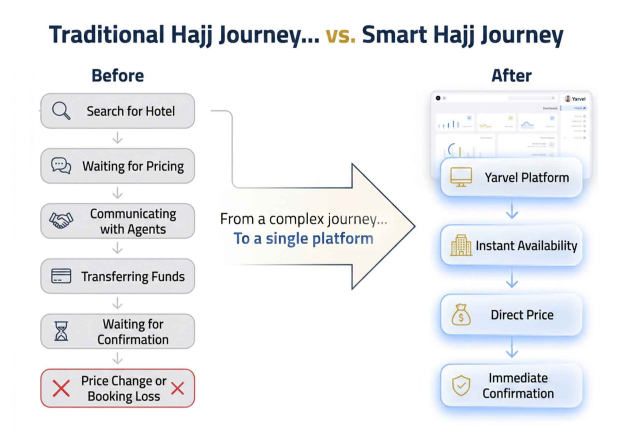
In many cases, the process begins with searching for availability, followed by waiting for pricing responses, communicating with one or more brokers, and then starting payment method before the reservation deadline expires.
During this period, availability may disappear or prices may increase suddenly, forcing companies to restart the entire process from the beginning.
He highlighted that these challenges were the primary driver behind creating a partnership that combines Safa Soft’s technological expertise with Go Sahl’s strong hotel network, focusing on combining all these stages into a single platform powered by real time availability and instant confirmation.
What Actually Changes?
From my perspective, it was important that the discussion went beyond announcing a new partnership and focused on understanding the actual value this technology brings to the market.
During the session, Eng. Hossam El Asaly summarized the key challenges addressed by the new solution, including:
- The difficulty of booking multiple rooms within the same hotel.
- Reliance on brokers to access availability and pricing.
- Price change during the booking process.
- Slow payment and financial transfer.
- Losing reservations before completing the required steps.
He explained that the new integration, reflected through the Yaravel platform, enables travel and Umrah companies to complete hotel reservations ranging from one room up to 15 rooms in a single transaction, while accessing actual availability and real time pricing at the moment of search.
This eliminates the need for lengthy traditional ways or dependence on informal communication channels such as social media groups.
Network Strength… The Foundation of Success
When the discussion moved to Eng. Mohamed Shanab, the key question was: Where does this hotel availability come from, and what differentiates Go Sahl from others?
He explained that Go Sahl has built an extensive network of direct partnerships with more than 80 service providers, hotel chains, and hospitality companies, giving it the ability to provide direct and reliable hotel availability.
He added that integrating this network into Safa Soft’s platforms will allow travel companies to search, compare, book, and receive instant confirmations through a unified platform, while automatically applying hotel policies, payment procedures, and providing the required Nusuk approval number for pilgrims.
From my perspective, the true value of this partnership is not only the size of the hotel network, but rather the transformation of this network into an accessible operational service within the daily workflow of Umrah companies, making every stage of the booking process part of one integrated experience.
Technology Alone Is Not Enough… It Must Handle Peak Seasons
The biggest challenge facing any technology platform is its ability to maintain efficiency during high demand seasons.
In this context, Eng. Mahmoud El Hefnawy explained that the technical infrastructure was a central element in designing the project, with an advanced integration machine developed to support thousands of booking transactions while maintaining response speed and data accuracy.
He highlighted that hotel availability is reflected instantly within the system, and once the booking and payment processes are completed, confirmation is issued immediately, significantly reducing the possibility of conflicts or price changes after completing the transaction.
Are We Witnessing a Change in the Way Umrah Companies Operate?
During the discussion, I realized that the most important question was not only about technology itself, but about its impact on the operational model of Umrah companies.
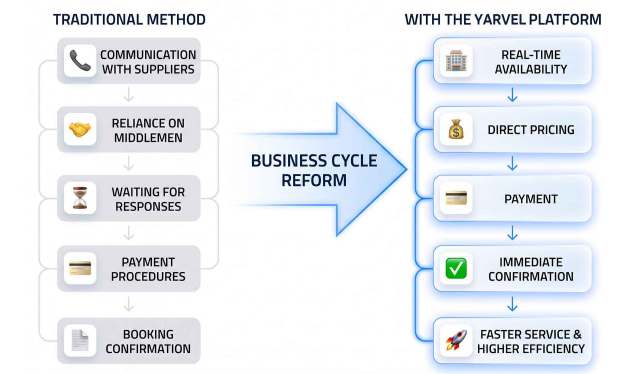
The answer was clear: this is not simply about replacing one booking method with another, it is about completely reshaping the operational cycle.
Instead of spending hours communicating with suppliers and brokers while waiting for responses, travel and Umrah companies will be able to complete reservations within minutes, with access to real availability, direct pricing, seamless payment, and instant confirmation.
This directly translates into faster customer service, improved operational efficiency, and stronger business profitability.
More Than an Agreement… A Vision for Sector Transformation
The key takeaway from this discussion is that the success of any technology project is not measured by the number of features it provides, but by its ability to solve real market challenges.
Today, the partnership between Safa Soft and Go Sahl represents a practical step in this direction. It brings together Safa Soft’s expertise in developing travel management systems with Go Sahl’s strong hospitality network to deliver a new model built on real time availability, direct booking, secure payments, and instant confirmation.
Although this partnership represents the beginning of a broader transformation journey, it reflects a clear vision toward building a more efficient and transparent ecosystem, one that reduces dependence on brokers and provides travel and Umrah companies with smarter operational tools.
Finally, the future of the Umrah sector will not be determined only by the number of contracts signed or hotels available, but by the ability of companies to hold technology to manage their operations more efficiently.
If this vision achieves its objectives, we may witness a fundamental transformation in the way hotel reservations are managed across the religious travel sector in the years ahead.


