When viewed together, Hajj statistics from the past decade tell the story of a market that faced an unique disruption, adapted through strategic planning, and has steadily regained momentum. The figures published by the General Authority for Statistics
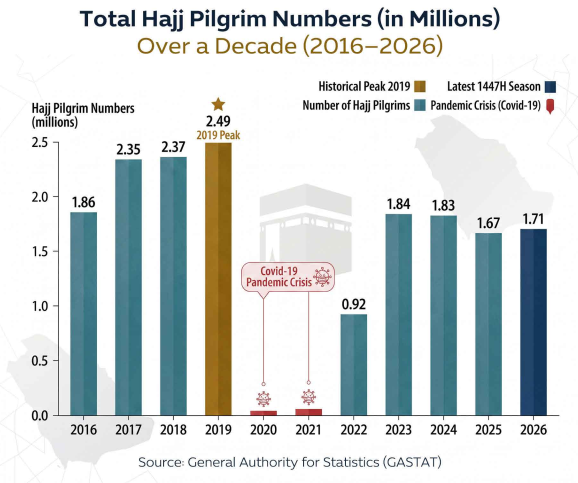
Figure (1): Total number of pilgrims 2016–2026 — Source: General Authority for Statistics.
• 2016–2018: Relatively stable at levels ranging between 1.86 and 2.37 million pilgrims annually.
• 2019: Historic peak of around 2.49 million pilgrims "the highest figure in the observed period"
• 2020–2021: Sharp collapse due to the pandemic to about just a thousand pilgrims in 2020, then 59,000 in 2021.
• 2022–2024: Gradual recovery from 926,000 (1443 AH) to 1.845 million (1444 AH) and then 1.833 million (1445 AH).
• 2025 (1446 AH): 1,673,230 pilgrims, of whom 1.5 million are from outside the Kingdom.
• 2026 (1447 AH): 1,707,301 pilgrims "latest official figure, with a slight increase over the previous year"
The decline from pre-pandemic Hajj numbers should not be explained as weak demand. The desire to perform Hajj remains constant; however, Saudi Arabia applies a carefully managed quota system that allocates pilgrim numbers to each country based on its Muslim population (approximately 10% of the Muslim people in each country). As a result, today's numbers reflect the quality of the pilgrimage experience and a well managed carrying capacity, rather than simply the capacity of pilgrims.
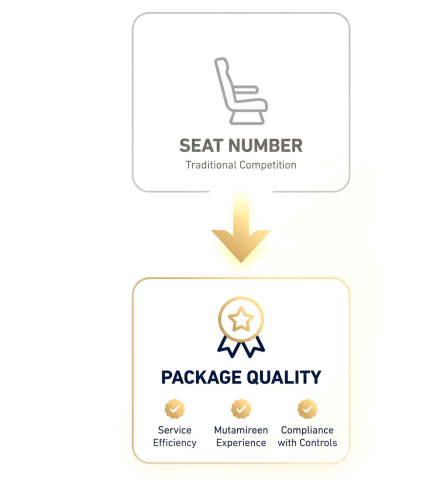
For travel and Umrah companies, the message is clear: competition is no longer defined by the number of available seats, but by the quality of the travel package and the efficiency of service delivery. As major infrastructure projects continue to progress, the market is evolving toward sustainable and carefully managed growth.