Umrah growth is closely linked to available capacity, making it one of the most accurate indicators for measuring the impact of regional disruptions on visitor flows to Saudi Arabia.
Unlike Hajj, which is a once in a lifetime religious duty that is difficult to delay, Umrah can be delayed or cancelled more easily. This makes it more sensitive to security developments, airfare fluctuations, and visa related decisions.
According to the Pilgrim Experience Program, the number of international Umrah pilgrims reached 16.92 million in 2024, nearly double the figure recorded in 2022. With Saudi Arabia's Vision 2030 target of welcoming 30 million Umrah pilgrims annually, the potential impact of the conflict can be explained through the following scenarios:
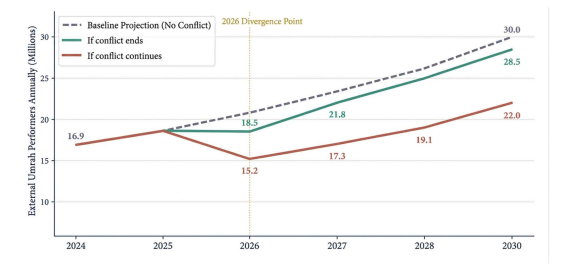
Before the conflict, the path was steadily moving toward achieving the 30 million Umrah pilgrims target by 2030, supported by several key factors, including the expansion of electronic visas covering more than 60 countries, the availability of Umrah services for holders of valid visas since October 2025, and the continued expansion of international air connectivity.
International Umrah numbers would experience a limited disruption in 2026, reaching approximately 18.5 million pilgrims instead of the projected 20.8 million, due to temporary visa suspensions and air travel disruptions.
However, recovery would resume quickly, bringing numbers close to 28.5 million pilgrims by 2030, a little below the original target but still aligned with the overall growth line.
International Umrah arrivals could decline to approximately 15.2 million pilgrims in 2026, applying Oxford Economics' estimated potential decline of up to 27%.
Recovery would slow due to continued airfare increases, repeated flight disruptions, and disrupts among travelers, potentially limiting arrivals to around 22 million pilgrims by 2030, creating a gap of approximately 8 million pilgrims compared to the target.
The increasing difference between these scenarios could represent tens of millions of visits over the coming four years, with direct effects for hotel revenues, transportation services, and retail activity in Makkah and Madinah.
However, early indicators from 2026 show that Umrah demand remains highly resilient and capable of rapid recovery once external restrictions are removed.


