At the time of publishing this newsletter (June 2026), the situation remained balanced on a weak ceasefire. Following the fire of fights on 28 February 2026, the Islamabad agreement was signed on 17 June, establishing a 60 day ceasefire and providing for the reopening of the Strait of Hormuz. However, the agreement continued to face doubt due to ongoing tensions along the Lebanese front.
Based on these developments, Oxford Economics outlined two possible scenarios for the region's tourism outlook:
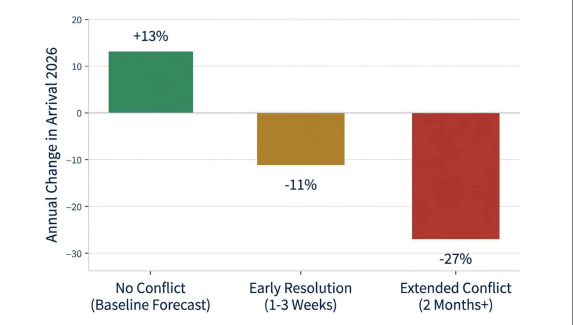
International arrivals declined by approximately 11% compared to the previous year, Around 23 million international visitors were lost. Traveler confidence begins recovering within approximately two months following the restoration of stability.
International arrivals fall by as much as 27%, Visitor losses reach 38 million, accompanied by approximately USD 56 billion in lost tourism spending. Gulf destinations experience the most significant impact due to their position as the region's primary tourism and aviation hubs.
The difference between these scenarios is essential. Even a relatively short extension of the conflict could translate into millions of lost visitors and billions of dollars in tourism revenue. sp, every indication of a stable ceasefire is reflected almost immediately in booking activity, while any renewed escalation quickly freezes demand and generates significant financial losses across the travel industry.
- Expected Impact on the Hajj & Umrah Season
These scenarios carry particular significance for religious tourism. Despite the conflict, the 2026 Hajj season shows remarkable resilience. Around 1,707,301 pilgrims successfully performed Hajj, including 1,518,153 international pilgrims, exceptional the previous year's total despite the cancellation of more than 27,000 flights across Gulf airports and the temporary suspension of visas for travelers from 14 countries.
If the conflict comes to an end, market confidence is expected to recover rapidly. Airfares would step by step decline as regional airspace fully reopens, allowing Umrah demand to regain momentum toward Saudi Arabia's objective of welcoming 30 million Umrah pilgrims annually by 2030, following the 18.5 million Umrah visits recorded in 2024. Historical trends consistently show that demand for religious pilgrimage rises within months once major disruptions subside.
On the other hand, if tensions continue, airfare prices are likely to remain elevated, having already increased by 20% to 50% across several key source markets. Umrah volumes may face additional pressure due to visa restrictions and continued airspace disruptions, potentially slowing progress toward the Kingdom's Vision 2030 targets.
Even so, Hajj remains unique. Unlike entertainment travel, its deeply rooted religious significance makes demand considerably more resilient during periods of geopolitical uncertainty, as clearly demonstrated throughout the 2026 season.
The lesson here is: The current situation today remains one of a weak ceasefire, making operational flexibility more important than ever. For Umrah operators, airlines, and travel companies, success will depend on building strategies that can adapt to either scenario, whether through surrounding fuel costs, diversifying departure gateways and flight routes, or preparing for the rush in delay demand that is expected once regional stability is fully stable.


