Since late February 2026, geopolitical tensions in the Middle East, driven by the conflict involving Iran, have significantly reshaped international travel ways. Air travel was immediately held as several countries closed their airspace, forcing major airlines to reroute flights, resulting in higher fuel uses, longer flight times, and increased operational costs.
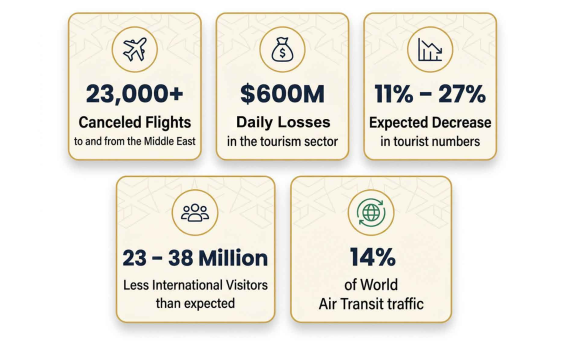
According to estimates published by the Financial Times and the World Travel & Tourism Council (WTTC), tourism spending across the Middle East was projected to reach USD 207 billion in 2026 before the dropping security situation altered those expectations. Data from Cirium and Oxford Economics further indicates that more than 23,000 flights to and from the Middle East were cancelled after the end of February, while the WTTC estimated the industry's daily losses at approximately USD 600 million.
Perhaps more significantly, the impact has extended well beyond the region itself. Oxford Economics projects that international arrivals to the Middle East could decline by 11% to 27% during 2026, representing a loss of 23 to 38 million international visitors and USD 34–56 billion in tourism spending. Given that the Middle East accounts for approximately 14% of global air transit traffic, disruptions in the region automatically affect international flight networks, affecting markets in Asia, Europe, and beyond.
For travel professionals, the lesson is clear: regional crises are no longer regional in their impact. Their consequences quickly spread through global fly and energy supply chains, influencing travel demand and operational costs worldwide.


