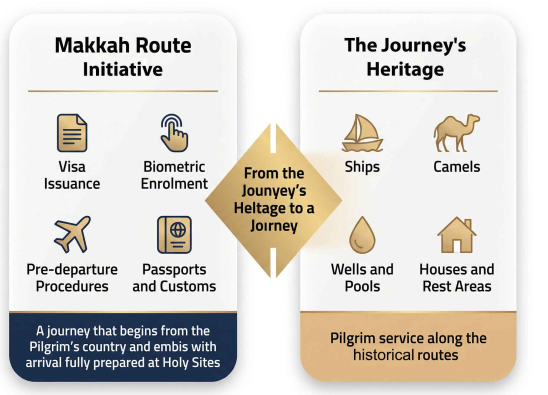
For centuries, the Hajj journey was defined by long and demanding travel across deserts and seas. Historic pilgrimage routes, such as the renowned "Zubaidah Trail", established by Zubaidah bint Ja'far to serve pilgrims from Iraq through wells, tanks, and rest stations, reflected the deep commitment of Islamic civilizations to caring for the Guests of Allah. Throughout history, maintaining these pilgrimage routes was regarded as both an honor and a responsibility embraced by rulers and states alike.
Today, this lasting legacy continues through the Makkah Route Initiative, which shifts key Hajj procedures to the pilgrim's country of departure. Visa issuance, fingerprint enrollment, passport control, and customs clearance are completed before boarding the flight, allowing pilgrims to arrive in Saudi Arabia with all entry procedures already finalized, eliminating lengthy airport processing upon arrival.
During the 1446H Hajj season, the initiative served pilgrims from eight participating countries, demonstrating how the Kingdom continues to modernize the pilgrimage experience while preserving its historical mission of serving the Guests of Allah.
The essence of caring for the pilgrim's journey has never changed for more than fourteen centuries. What has evolved are the tools, from wells and caravan stations to digital platforms, integrated data systems, and smart technologies.
This is exactly where technology finds its most meaningful role: supporting a mission that has been serving pilgrims for over fourteen centuries.


