Introduction
There is a paradox in this year’s Umrah market that deserves a moment’s attention.
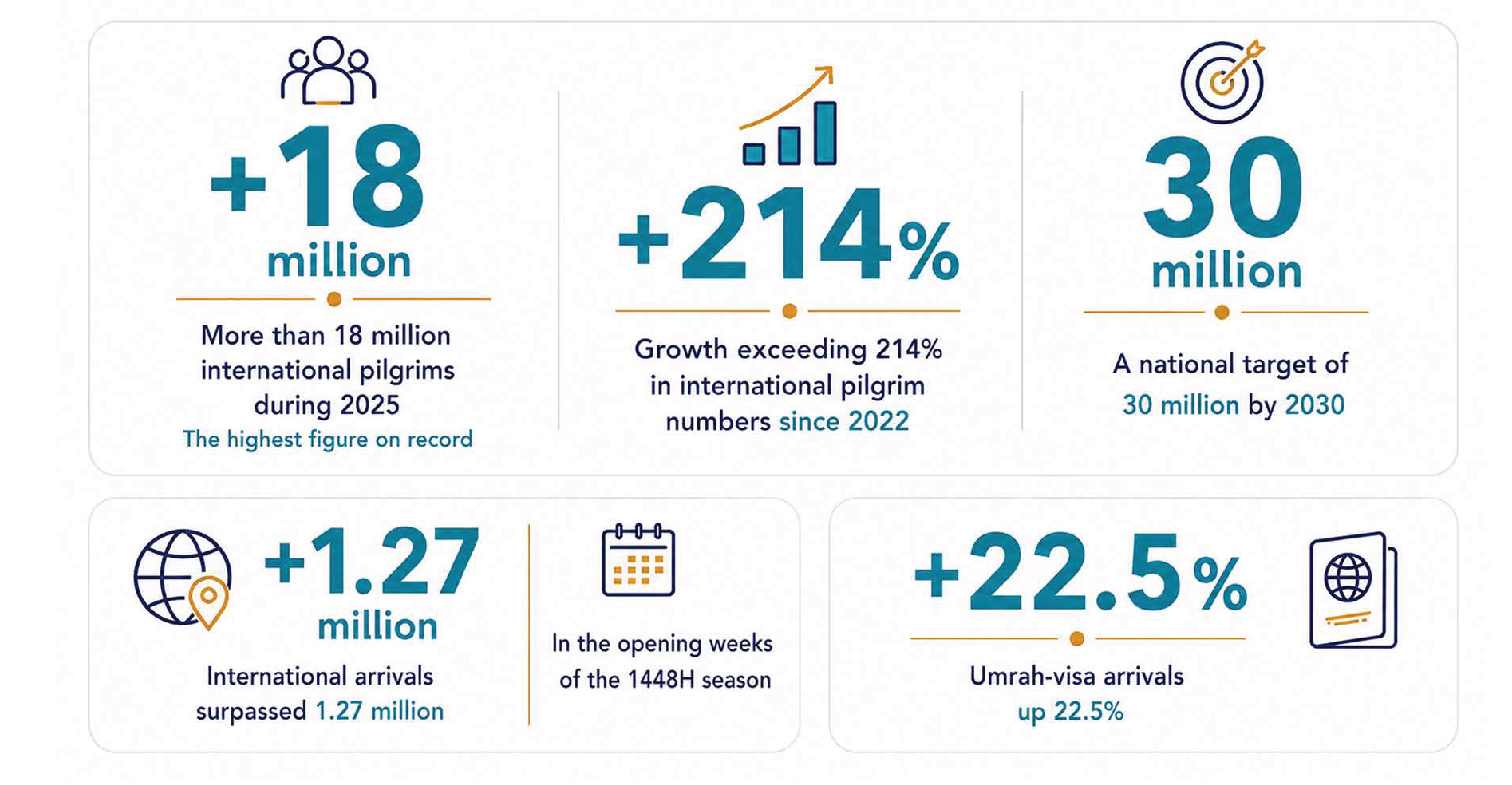
On one side, every indicator points upward: more than 18 million international pilgrims during 2025 — the highest figure on record — growth exceeding 214% in international pilgrim numbers since 2022, and a national target of 30 million by 2030. In the opening weeks of the 1448H season alone, international arrivals surpassed 1.27 million, with Umrah-visa arrivals up 22.5%.
On the other side, a considerable number of Umrah companies describe the same period as harder than before: thinner margins, faster price comparison, and a customer who is better informed and less patient.
How can a market grow while the companies operating within it feel squeezed?
The ready answer is familiar: “the digital platforms are taking our share.” The instinct is understandable, but the diagnosis is inaccurate — and decisions built on an inaccurate diagnosis are expensive, because they push a company to defend a position it has already lost instead of moving to the one now open to it.
The more precise explanation is that digital transformation has not taken from the market; it has redistributed where value sits within it. Some activities that once produced a healthy return no longer do. And some things once given away as an “extra service” have become the real source of differentiation.
This article sets out to answer three practical questions:
1. What has genuinely moved into the digital ecosystem?
2. What has remained with the Umrah company — and why will it remain?
3. And how can a company measure, concretely, where it stands today?
One: What has genuinely moved?
Let us be precise about the diagnosis before discussing conclusions.
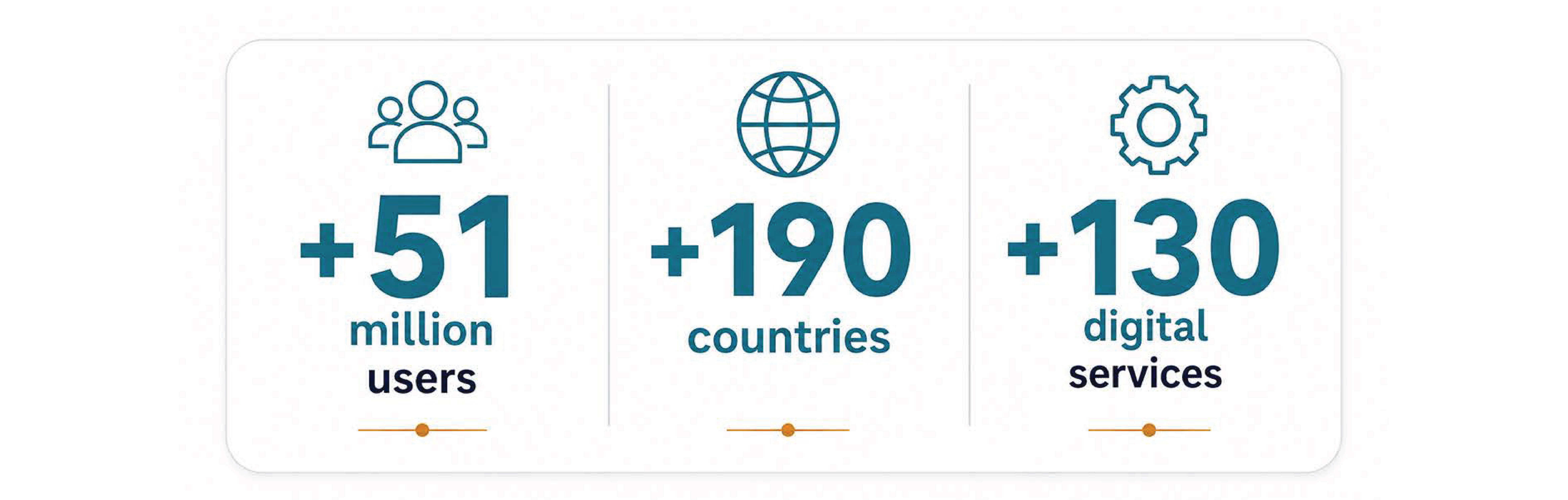
Today’s digital ecosystem — with more than 51 million users across over 190 countries, and more than 130 digital services — has absorbed four functions that belonged to the Umrah company for decades:
Availability: knowing which rooms, flights and slots exist.
Booking: completing the transaction directly, without an intermediary.
Payment: secure, documented collection.
Documentation: issuing the visa and linking it to the rest of the journey.
For many years these four represented a substantial share of a company’s value, and a substantial share of its margin. There is no use pretending that part of that value has not genuinely shifted.
The analytical error begins at the next step: assuming that this shift means a diminished role for the company. The numbers do not support that assumption.
Digitalisation did not take a slice from a fixed pie. It doubled the pie — and then moved the location of the Umrah company’s slice. Anyone who missed the second movement will experience the first as a loss.
Two: The four spaces that did not move
What remains is larger than what moved. It can be summarised in a single line: everything that happens after the customer presses “confirm.” Digitalization delivers the transaction; it does not carry responsibility for the outcome.
Digital platforms execute a clear request superbly. What follows sits outside their design by nature — not as a shortcoming, but because it was never their function:
The case that does not fit the dropdown. The pilgrim using a wheelchair. The companion on a different visa category. The group carrying three nationalities across three visa tracks. The medical condition requiring a hotel at a specific walking distance from the Haram, not simply “four stars.” Each of these needs a human judgement, not a menu option.
The group, not the individual. Most Umrah traffic is not individual: families, mosque groups, corporate programmes, organised parties from source markets. Coordinating forty passports, with staggered arrival times and a single shared budget, is not a booking task. It is a full operational undertaking.
The moment something changes. This is the decisive territory. In a regional environment still seeing adjustments to flight schedules and routings, the post-booking phase has become the most sensitive stretch of the journey. A flight that shifts, a hotel that cannot honour a reservation, a visa that runs late — in none of these moments does the customer call an app.
The platform sells the promise. The company is what delivers it — particularly when it falters.

Reassurance. A first-time pilgrim, spending a sum that is significant relative to his income, on a journey whose meaning to him is not measured in money. That person wants a human voice saying: we are on it, don’t worry. That is not a function that can be automated.
Source-market knowledge. A platform is global by design; a company is close to its market by presence. Understanding Pakistan — the largest source market at the season’s opening with 200,000 pilgrims — or Indonesia with 170,000, or Iraq with 130,000, including the language, the channels, the payment behaviour and the customer expectations, is an advantage no dashboard replicates.
Three: The three-layer model
The clearest way to organise all of this is to see the pilgrim’s journey as three layers, each with a different owner:
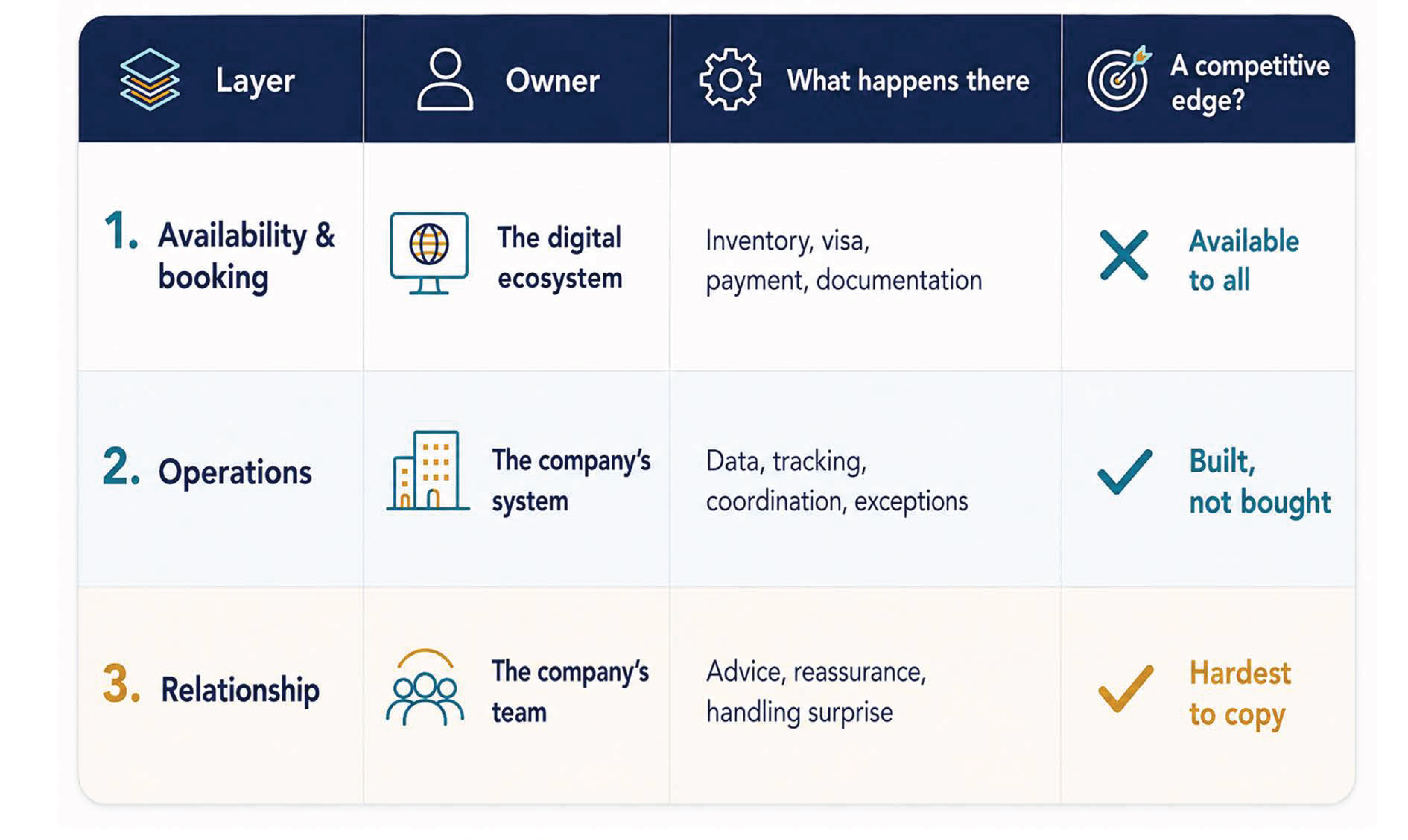
The companies under the most pressure today are, for the most part, those still trying to compete inside the first layer — selling access to something everyone can now access. The companies that are growing have moved their centre of gravity into the second and third.
And here is the connection many miss: the third layer cannot function if the second is fragmented.
A staff member who must open five systems, an Excel file, a WhatsApp thread and an email chain to answer one simple question does not have the time to be an advisor. He is busy being a data collector.
Good technology does not replace the team. It frees the team to do the work technology cannot do.
Four: The question worth a management meeting
A pilgrim today can select his nights in Makkah and Madinah, add meals, book a Rawdah slot, arrange transport, pay, and receive his visa — all of it himself, on his phone, without speaking to anyone.
Which is why the question worth putting on the agenda of your next management meeting is not “how do we compete with the digital platforms?” It is:
“What do we provide that our customer cannot obtain for himself, on his phone?”
If the answer is clear, specific and measurable, the company is well positioned — and its task is to build around that answer and price it with confidence, rather than continuing to give it away.
If the answer is vague, that is, without exaggeration, the most valuable outcome this month’s meeting can produce.
Conclusion
The article can be reduced to three points.
First: the market is growing. The pressure companies feel is not a contraction in demand, but a redistribution of where value sits within the market itself.
Second: what moved into the digital ecosystem is access to the service. What has remained — and will remain — is management of the service: the exception, the group, the change, the reassurance, and knowledge of the market.
Third: the ability to deliver that management is not a matter of good intentions within the team. It is a direct consequence of the quality of the systems the team works with. A company whose staff spend their time searching for information will not be able to offer advisory service, however capable those staff may be.
This is where the real distance appears between a company chasing growth and a company ready for it.
Value in the Umrah sector has not disappeared. It has moved — from access to the service, to management of the service.
Those who recognise that shift early do not lose to digital transformation; they are the first to benefit from it.


